Higher education — Mobile app
WAPI — Digital student card
The digital student platform for the University of French Guiana: a paperless student ID card with QR code, library access and sports sign-up, on web, iOS and Android.
Context
The University of French Guiana had obtained a quote from an outside vendor to digitize its paper student card. Rather than depend on that off-the-shelf solution, the university chose to have its own platform built in-house, fully under its control.
Problem
The university issued its student card as a printed, laminated card handed out by hand: a staff member tied up for months each year, trips to campuses in Kourou and Saint-Laurent-du-Maroni, and no digital services for students.
Objectives
- Replace the paper card with a digital card and QR code
- Grant library access via QR code scan
- Enable sports sign-up from the app
- Lay a technical foundation reusable for future student modules
Users
Students across the three campuses (Cayenne, Kourou, Saint-Laurent-du-Maroni), library and sports staff who verify cards, and administrators who import data and track indicators.
Proposed solution
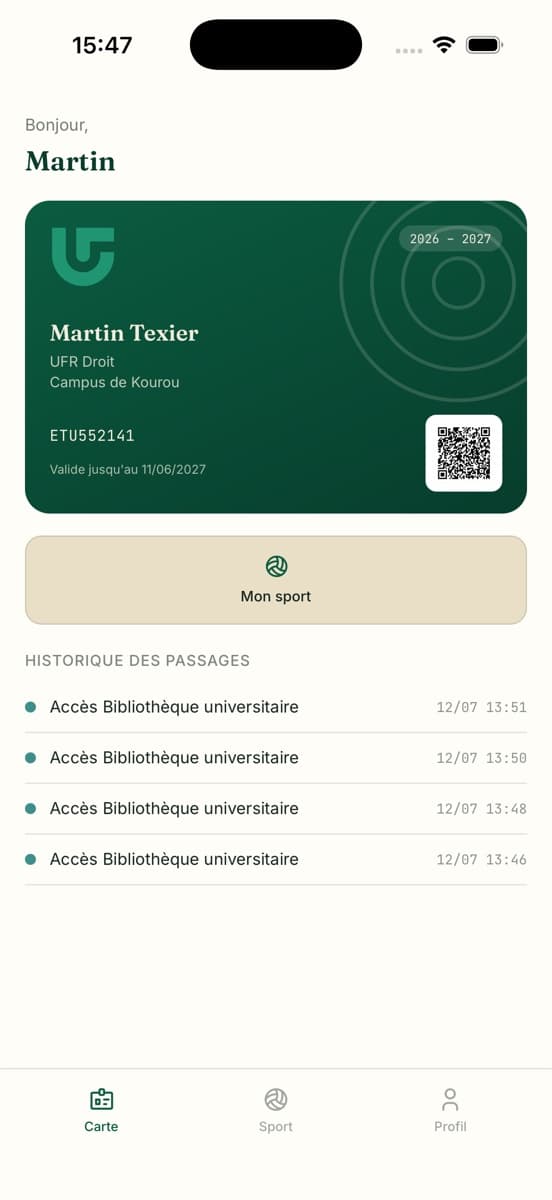
A fully digital card with a signed QR code, available in a mobile app (iOS/Android via Capacitor, plus a web PWA), a back office for library and sports staff, and a technical foundation designed to support future modules (schedule, mobility, dining).
Architecture
A Laravel backend (web back office + API) and an independent Vue 3 student app, packaged as both a web PWA and real iOS/Android apps via Capacitor. Every card carries a signed QR identifier, verified server-side and logged on every scan.
Features
- Digital student card with signed QR code
- Camera-scan or manual verification (library and sports staff)
- Sports sign-up from the app
- Access history viewable by the student
- Admin dashboard with key indicators
- Native iOS and Android apps (Capacitor) + web PWA
- Student account import, roles and permissions
Technical choices
The student app was built as a standalone project consuming a token-based API (Sanctum), so it could ship as both a PWA and native apps without duplicating business logic. The visual identity (palette, typography, icons) carries the university's official colors and logo across all three platforms.
Challenges
The main challenge was shipping a solid, well-tested foundation without any integration with the university's existing student records system: a CSV import serves as a transitional solution, with validation and an error report, pending a real connection to the university's systems.
Outcomes
The platform is built, tested and functional: a multi-role back office, an API, and a mobile app validated on the iOS simulator and Android emulator. Going live still depends on a hosting decision and an account-activation mechanism on the university's side.
- In-house alternative to an outside vendor's quote of €211,531 over 3 years
- Working app tested under real conditions on iOS and Android
What's next
- Self-service student account activation
- Production rollout and app store publishing
- New modules: schedule, mobility, dining